As an Amazon Associate I earn from qualifying purchases.
Every pilot should carry a handheld aviation transceiver. Whether your panel-mount radio fails, you need to communicate after an off-airport landing, or you're building flight hours in aircraft with marginal avionics, a quality handheld VHF radio is essential safety equipment that belongs in your flight bag.
The challenge is choosing one that will actually work when you need it, with sufficient output power for air traffic control communication, battery life that lasts through extended flights, and features that enhance rather than complicate cockpit operations.
Table Of Contents
- Top Pick: Icom IC-A25N – The Benchmark for Serious Pilots
- What to Look for in Any Handheld Aviation Radio
- Making the Right Choice for Your Mission
- Practical Considerations Beyond Specifications
- Final Recommendation
Top Pick: Icom IC-A25N – The Benchmark for Serious Pilots
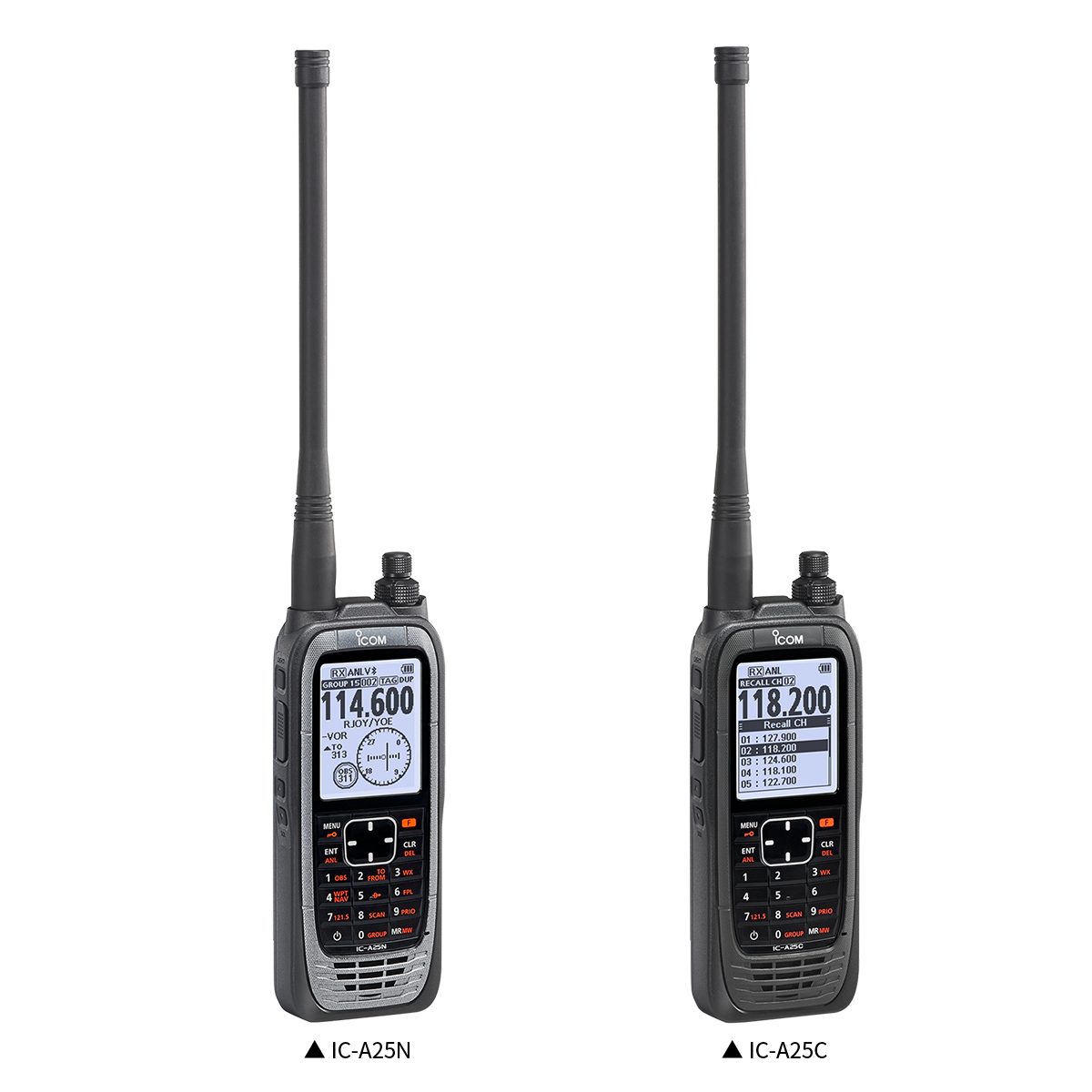
For pilots who want professional-grade backup communications, the Icom IC-A25N VHF Air Band Handheld Radio sets the standard with integrated GPS and Bluetooth connectivity that goes beyond basic transmit-and-receive functionality.
Why the IC-A25N Stands Out
This radio delivers approximately 6 watts PEP of transmission power, up from the 5 watts of the previous IC-A24, which Icom says expands its communication coverage. The integrated GPS automatically displays your position coordinates, which proves invaluable during emergency communications when controllers need your exact location.
The Bluetooth capability lets you pair the radio with compatible aviation headsets, eliminating the need to hold the radio to your ear in noisy cockpit environments. A dedicated 121.5 MHz emergency key jumps straight to the guard frequency without retuning by hand.
Battery Performance That Matters
The IC-A25N operates for approximately 10.5 hours on a single charge under typical usage patterns (5% transmit, 5% receive, 90% standby). The included lithium-ion battery pack provides better cold-weather performance than NiMH alternatives, critical if you fly in northern climates where your flight bag might spend nights in an unheated hangar.
It ships with the BP-288 2350 mAh battery pack and a BC-224 rapid charger, and a battery status screen reports the pack's condition so you can judge whether it will last a long day of flying.
Navigation Database Feature
The IC-A25N stores up to 300 memory channels in 15 memory groups, each with a 12-character name, plus up to 300 waypoints and 10 flight plans for its simplified waypoint navigation. Programming your home airport's tower, ground, and approach frequencies ahead of the flight means recalling them by name instead of dialing them in, which cuts heads-down time and frequency entry errors.
What to Consider
The IC-A25N represents a significant investment compared to basic handhelds. The feature set makes most sense for:
- Pilots who fly IFR or in complex airspace where GPS position reporting and rapid frequency changes matter
- Flight instructors who need reliable backup communications across multiple aircraft daily
- Pilots flying long cross-countries where battery life becomes a practical necessity
- Aircraft owners who want one professional-grade radio that serves as both cockpit backup and ramp-to-tower communications
The unit measures approximately 5.9" × 2.3" × 1.5" with the antenna and battery attached, compact enough for a flight bag side pocket but substantial enough that you'll know it's there.
What to Look for in Any Handheld Aviation Radio
Before comparing specific models, understand the features that separate adequate handhelds from truly useful ones:
Transmission Power
Look for radios rated at 5-6 watts output. Lower-powered units (1-2 watts) may work fine for ground communications with the FBO, but struggle to reach approach control from pattern altitude when you need them most. Transmission power directly affects your communication range, especially when operating at lower altitudes where line-of-sight VHF propagation is limited.
Frequency Coverage and Memory Channels
Your radio should cover the full aviation VHF band (118.000-136.975 MHz); the IC-A25N supports both 25 kHz and 8.33 kHz channel spacing. Memory channels let you pre-program your home airport tower, approach, ground, and commonly-used frequencies for one-button access rather than manual tuning during high-workload phases of flight.
Battery Chemistry and Runtime
Lithium-ion batteries outperform older NiMH technology in several ways: they hold charge longer during storage (critical for an emergency backup device), perform better in cold weather, and typically provide longer runtime per charge. Calculate whether the advertised battery life meets your typical flight duration plus a safety margin, a radio that dies halfway through a cross-country flight isn't much help.
Audio Output and Headset Compatibility
Built-in speakers work fine on the ground but become nearly useless in a noisy cockpit. Look for either Bluetooth connectivity for wireless headset pairing, or at minimum a headphone jack that accepts standard aviation headset plugs. Some radios include VOX (voice-activated transmission) capability, though this feature can be problematic in high-noise cockpit environments.
Display Readability
You'll use this radio in bright sunlight and potentially at night. Backlit displays with adjustable brightness and large, high-contrast numbers make frequency verification easier when you're task-saturated. The ability to read the active frequency at a glance, without squinting or tilting the radio, matters more than you might think during actual use.
Making the Right Choice for Your Mission
Your ideal handheld aviation radio depends on how you fly:
For primary flight training students, a radio with solid fundamentals, good transmission power, clear audio, and intuitive frequency entry, serves you well without features you won't use until you have more experience. Focus on battery life that covers your typical lesson duration plus reserve time.
For instrument-rated pilots and IFR operations, GPS integration and rapid frequency changes become valuable. The ability to quickly report your position to ATC and switch between approach, tower, and ground frequencies without fumbling supports smoother operations in busy terminal airspace.
For backcountry and remote-area pilots, maximum transmission power, extended battery life, and reliable cold-weather performance take priority. Your handheld may be your only communications option after a precautionary landing in terrain where line-of-sight to the nearest receiver is marginal.
For aircraft owners building a comprehensive safety kit, view your handheld radio as backup communications that should match or approach your panel-mount capabilities. If you have Bluetooth headsets in the cockpit, a compatible handheld integrates seamlessly if you ever need to switch.
The Icom IC-A25N addresses all these missions with professional-grade capabilities, making it the most versatile choice for pilots who want equipment that won't limit their operations or compromise safety when backup communications become primary communications.
Practical Considerations Beyond Specifications
Testing and Familiarity
The best handheld radio is worthless if you've never turned it on before the emergency that requires it. Program your frequencies, practice basic operations, and periodically verify the battery holds a charge. Many pilots discover dead batteries or forgotten programming codes only when they actually need the radio.
Legal and Regulatory Notes
Transmitting on aviation frequencies is governed by FCC rules and is not something to experiment with: these are not general-purpose communication devices. Check the current licensing requirements that apply to your operation before you transmit.
Maintenance and Storage
Store your radio with the battery removed or on a maintenance charge cycle per the manufacturer's instructions. Lithium-ion batteries degrade when stored fully discharged. Keep the radio in your flight bag where you'll actually have it available, not on a shelf at home. Include a printed frequency card for your common airports, technology fails, paper doesn't.
Final Recommendation
The Icom IC-A25N VHF Air Band Handheld Radio represents the level of capability serious pilots should carry. Its integrated GPS, Bluetooth connectivity, comprehensive frequency database, and maximum allowable transmission power create a backup communications system that genuinely replicates panel-mount functionality rather than merely providing a minimal emergency option.
For pilots who view handheld radios as true safety equipment rather than a checkbox item, the IC-A25N delivers professional features that work exactly when you need them most, whether that's communicating your position after an electrical failure, coordinating with ATC during an avionics malfunction, or simply making ramp calls when the panel radio stays cold on a winter morning.
Quality emergency equipment costs more than basic alternatives, but the IC-A25N's feature set justifies the investment for pilots who regularly operate in environments where reliable backup communications directly contributes to safe flight operations.
Disclaimer: Some articles on this site are created with the assistance of AI technology. While we work to keep our content accurate, it may contain errors or outdated information, so please verify important details before relying on them.