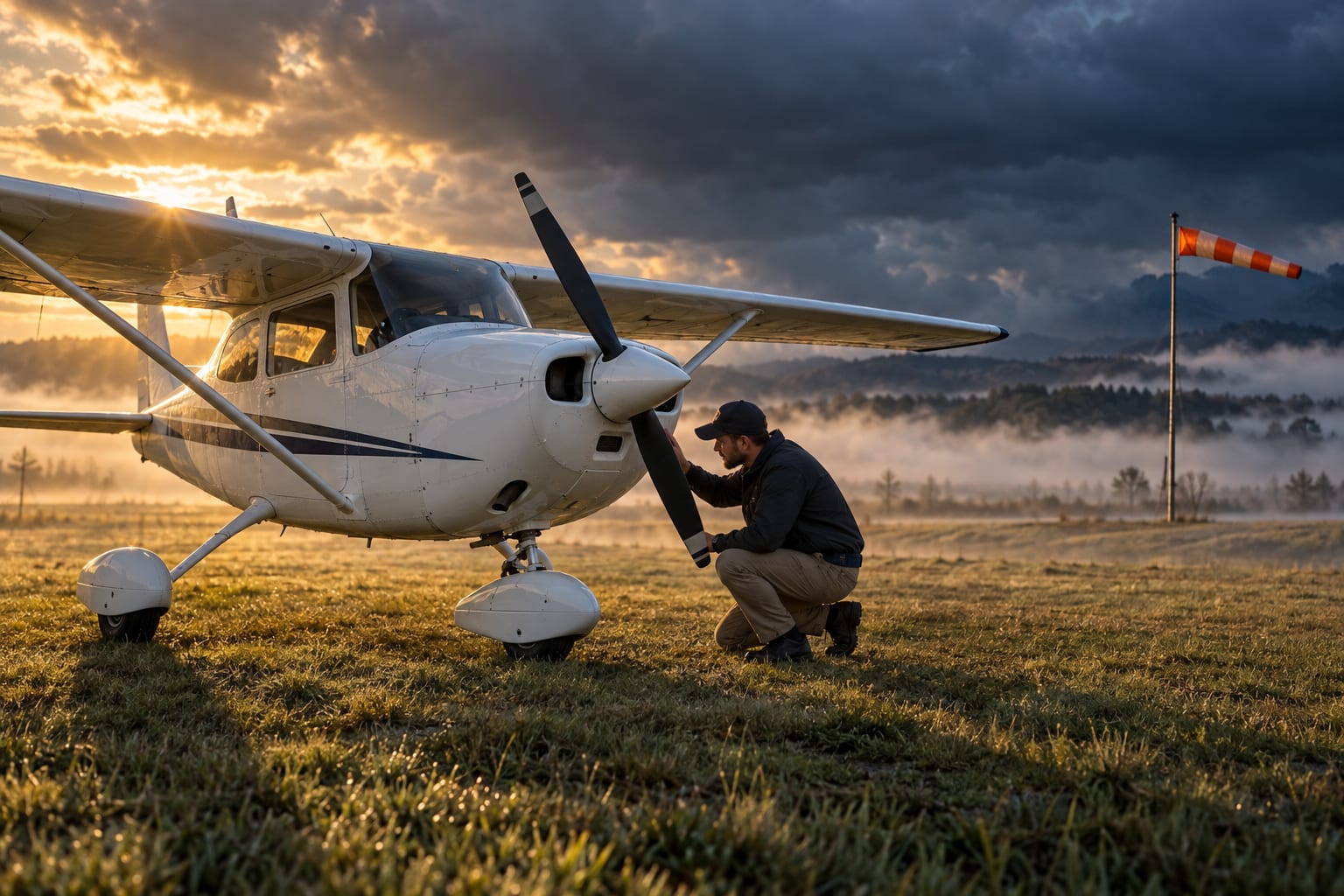
Most people who are afraid of flying are afraid of the wrong thing. Commercial airline travel is statistically one of the safest forms of transportation ever devised. The aircraft worth thinking carefully about are the small ones: the Cessna 172 on a cross-country trip, the Piper Cherokee in the traffic pattern, the experimental kitplane departing a grass strip at dawn. General aviation carries a fundamentally different risk profile than airline flying, and understanding exactly why small planes crash is the most important thing any pilot, passenger, or aviation enthusiast can do to stay safe.
Here is the honest answer: most small airplane crashes are not random. They are not acts of God or unavoidable mechanical catastrophes. They follow identifiable, repeating patterns, and that means they are largely preventable. Let me walk you through the real causes.
Table Of Contents
- General Aviation vs. Commercial Aviation: Why the Safety Gap Is So Wide
- Pilot Error and Decision-Making: The Dominant Causes of GA Accidents
- Weather: The Invisible Threat to Small Aircraft
- Mechanical Failure, Maintenance, and Environmental Risk Factors
- How to Make General Aviation Safer: What the Data Tells Us
- Conclusion
- Sources
General Aviation vs. Commercial Aviation: Why the Safety Gap Is So Wide
General aviation broadly covers everything that is not commercial airline or military flight. That includes private aircraft, flight training, agricultural operations, charter, air tours, and experimental aircraft. It is an enormous and diverse category, and that diversity is part of what makes the safety picture complicated.
The gap between GA and commercial aviation safety is not subtle. The FAA's General Aviation and Part 135 Activity Survey has placed the GA fatal accident rate at roughly 1.0 fatal accident per 100,000 flight hours [1]. Commercial air carriers operate at a rate orders of magnitude lower. That is not a marginal difference. It is a structural one, and the reasons behind it are worth understanding in detail.
Commercial airline crews operate under two-pilot requirements, meaning there is always a check on decision-making. Their aircraft have redundant systems at every critical level: dual hydraulics, multiple generators, backup navigation, and automatic failure alerting. Airlines mandate recurrent simulator training multiple times per year, and captains face regular proficiency checks that can end a career if standards slip. The operating environment is also more controlled, with major airports, instrument approaches, ATC separation, and standardized procedures at every turn.
GA pilots, by contrast, often fly single-pilot in aircraft with a single engine, basic avionics, and no autopilot. The minimum requirement to maintain a private pilot certificate is a flight review: one hour of ground and one hour of flight training every two years, per 14 CFR §61.56. That is not a proficiency standard; it is a minimum threshold. The operating environments GA pilots choose are far more varied: backcountry strips, unfamiliar mountain airports, night flights over dark terrain, and cross-countries into deteriorating weather.
None of this means GA is irrational or should be avoided. It means the pilot carries a far greater share of the safety responsibility than any airline passenger ever will. That is both the freedom and the burden of general aviation.
Pilot Error and Decision-Making: The Dominant Causes of GA Accidents
If you want to understand why small planes crash, start here. Pilot error is the dominant factor in the overwhelming majority of GA accidents. NTSB accident data and AOPA Air Safety Institute Nall Reports consistently place pilot-related causes at roughly 70 to 75 percent of all GA crashes [2]. That number should not be read as an indictment of pilots as a group. Read it as a map. If most crashes trace back to pilot decisions, then improving pilot decision-making is where the highest return on safety investment lies.
"Pilot error" is also a misleading label if you imagine it means recklessness or stupidity. Most of the time it means something more subtle: a misjudgment under pressure, a knowledge gap at the wrong moment, a decision that seemed reasonable until it was not.
Loss of Control In-Flight (LOC-I)
Loss of control in-flight is consistently one of the deadliest accident categories in general aviation, identified as the leading cause of fatal GA accidents across multiple FAA and NTSB studies. It is particularly unforgiving because it most often occurs at low altitude during takeoff, maneuvering flight, or the base-to-final turn in the traffic pattern, where there is simply no room to recover.
The underlying mechanics are usually a stall or incipient spin. A pilot slows below stall speed while turning, the inside wing drops, and the aircraft departs controlled flight at 500 feet above the ground. At that altitude, recovery is not possible. The FAA has invested heavily in stall awareness and angle-of-attack education precisely because this pattern keeps repeating. The fix is not exotic. It is consistent stall recognition training and a disciplined respect for airspeed in the pattern.
Controlled Flight into Terrain (CFIT) and Spatial Disorientation
CFIT is exactly what it sounds like: a pilot flies a perfectly airworthy aircraft into the ground, a hillside, or an obstacle. The aircraft is functioning. The pilot is alive and in control. And yet the flight ends in terrain contact, usually because of low visibility, night conditions, or spatial disorientation.
The most common scenario involves a VFR pilot who inadvertently enters instrument meteorological conditions. Without visual references, spatial disorientation develops rapidly. The vestibular system is not calibrated for flight. It will convince a pilot in a graveyard spiral that they are flying straight and level, a phenomenon documented in FAA Pilot's Handbook of Aeronautical Knowledge Chapter 17. Without the instrument scan discipline to override those sensory illusions, controlled flight into terrain is the predictable outcome.
VFR pilots are legally prohibited from entering clouds or flying below certain visibility minimums, but the accident record shows that prohibition is violated regularly, and almost always with fatal results.
Poor Aeronautical Decision-Making (ADM) and Fuel Mismanagement
The thread running through most LOC-I and CFIT accidents is poor aeronautical decision-making: specifically, the failure to recognize a deteriorating situation and act before options run out. "Get-there-itis" is the colloquial term for the psychological pressure that keeps pilots pressing into worsening conditions when the correct decision is to turn around, divert, or cancel.
Fuel mismanagement is another ADM failure that kills pilots every year. Running an aircraft out of fuel is not a mechanical problem. It is a planning and monitoring failure. The fuel gauges are right there. The math is straightforward. Yet fuel exhaustion and fuel starvation remain persistent causes of GA engine failures, documented consistently in NTSB accident reports and AOPA ASI Nall Reports.
Weather: The Invisible Threat to Small Aircraft
Commercial jets fly above most weather. They carry onboard radar, de-icing systems, and dispatch teams monitoring conditions in real time. A GA pilot in a Cessna 172 at 8,500 feet is flying through the same weather everyone else is dealing with, and doing it with far fewer tools to manage it.
Weather is a contributing factor in a significant portion of fatal GA accidents. The AOPA Air Safety Institute's Joseph T. Nall Report has consistently identified weather as one of the top contributing factors in fatal GA crashes, particularly in the categories of VFR-into-IMC and icing encounters.
Icing is fast, dramatic, and difficult to reverse once established. Even a thin layer of frost on a wing degrades lift and increases stall speed. Most light GA aircraft are not certified for flight into known icing conditions. Pilots who encounter icing unexpectedly, or who press into conditions they misjudged, can find themselves in serious trouble quickly, especially at lower altitudes where escape options are limited.
No light aircraft belongs anywhere near a thunderstorm cell. The turbulence, wind shear, microbursts, and hail associated with convective activity exceed the structural limits of most GA aircraft. The FAA Aeronautical Information Manual recommends avoiding thunderstorm cells by at least 20 nautical miles, and for good reason: severe turbulence can exist well beyond the visible cell. The temptation to thread the needle between cells on a radar display is one of the more seductive and dangerous decisions a GA pilot can make. Weather radar shows precipitation, not turbulence. The gaps between cells are not safe corridors.
Mechanical Failure, Maintenance, and Environmental Risk Factors
Mechanical failure gets more attention in the public imagination than it deserves statistically, but it is a real factor in a meaningful minority of GA accidents. More importantly, most mechanical failures that lead to accidents involve some element of maintenance neglect or pre-flight oversight, which means they are preventable.
Engine failure is the mechanical event GA pilots fear most. The causes are varied: carburetor icing, fuel contamination, improper maintenance, oil starvation, and component fatigue. The U.S. GA fleet is old. The FAA's General Aviation and Part 135 Activity Survey has documented that the average age of active GA aircraft is well over 40 years [1]. Aging components require more vigilant maintenance, not less.
The important counterpoint is that engine failure in a properly piloted aircraft is survivable in many scenarios. A pilot trained for engine-out procedures who maintains best glide speed and selects the best available landing area has a reasonable chance of walking away. The accidents that turn fatal are often those where the pilot abandons the glide to attempt a return to the runway after a departure-end engine failure, a maneuver that has killed countless pilots in aircraft that were fully capable of a successful off-airport landing straight ahead.
Fuel contamination, specifically water in avgas, is a preventable cause that continues to claim lives. Sumping the fuel tanks during pre-flight is a five-minute task that eliminates one of the most insidious causes of engine failure on departure. There is no excuse for skipping it.
Beyond mechanical issues, several situational factors consistently appear in accident chains. Night flying significantly increases risk for pilots without instrument ratings. The visual cues that make attitude control intuitive in the daytime disappear, terrain blends into darkness, and the margin for error in the traffic pattern shrinks considerably. A disproportionate share of GA accidents also occur during takeoff, initial climb, approach, and landing, the phases that concentrate the highest workload, the lowest altitude, and the least energy state into the smallest window of time.
High-density altitude operations add another layer of risk. At high elevations or in high temperatures, engines produce less power, propellers generate less thrust, and wings produce less lift. A pilot trained exclusively at sea-level airports who arrives at a 6,000-foot mountain strip on a hot afternoon may be operating an aircraft that performs nothing like what they are accustomed to. Takeoff roll extends dramatically. Climb rate is anemic. Mountain flying demands specific training and honest performance calculations before every departure.
How to Make General Aviation Safer: What the Data Tells Us
The accident record is not just a catalog of failures. It is a detailed instruction manual for what to do differently. The patterns are clear enough that targeted action produces real results.
Train beyond the minimums. The private pilot certificate is a license to learn, not a declaration of proficiency. An instrument rating is one of the highest-value safety investments a VFR pilot can make. It does not just allow flight in IMC; it builds the scan discipline, the decision-making framework, and the weather knowledge that make every flight safer. Recurrent training, scenario-based flight reviews, and programs like the FAA WINGS Pilot Proficiency Program build the kind of currency that reduces accident risk in measurable ways.
Use decision-making frameworks consistently. The IMSAFE checklist (Illness, Medication, Stress, Alcohol, Fatigue, Emotion) is a structured self-assessment that takes 60 seconds and has no downside. The PAVE checklist (Pilot, Aircraft, enVironment, External pressures) is a preflight risk framework that forces you to examine the full picture before committing to a flight. Building personal minimums, specific written limits for visibility, crosswind, and night currency, removes the in-flight negotiation that get-there-itis feeds on. Decide your limits on the ground, in a calm moment, not at cruise altitude with a destination 45 minutes ahead.
Use technology as a force multiplier. ADS-B traffic awareness, moving map GPS, and tablet-based weather applications have meaningfully improved situational awareness for GA pilots over the past decade. Angle-of-attack indicators provide a direct, intuitive read on stall margin that airspeed alone does not. Autopilots reduce workload and fatigue in cruise, freeing attention for monitoring and decision-making. None of this technology replaces judgment, but used correctly, it extends the pilot's awareness in ways that directly address the accident causes outlined above.
Build a personal culture of safety. The pilots with the longest, safest careers are not the most fearless. They are the most willing to cancel, divert, and say no. Reading NTSB accident reports, not as cautionary tales about other people's failures but as decision trees that could apply to any of us, is one of the most efficient safety education tools available.
Conclusion
Small airplane crashes are not random, and they are not inevitable. They follow identifiable patterns rooted in pilot decision-making, weather judgment, mechanical vigilance, and situational awareness. The pilot who understands those patterns and builds their training, habits, and personal minimums around them is operating in a fundamentally different risk environment than the one who does not.
General aviation is unforgiving of complacency. It rewards preparation, discipline, and honest self-assessment with long, safe flying careers. The data is clear on what causes crashes. What you do with that knowledge is up to you.
Want to go deeper on GA safety? Browse our full library of general aviation safety articles, explore instrument rating training options, or download our free preflight decision-making checklist to build your personal minimums framework before your next flight.
Sources
Disclaimer: Some articles on this site are created with the assistance of AI technology. While we work to keep our content accurate, it may contain errors or outdated information, so please verify important details before relying on them.