Picture this: a prospective buyer is standing in your hangar, pre-buy inspection underway, and the IA asks for the compliance record on a specific recurring airworthiness directive. You dig through a stack of worn binders, a folder of loose papers, and two shoeboxes of maintenance receipts and come up empty. The sale stalls. The buyer walks. That scenario plays out more often than it should, and it's entirely preventable.
Disorganized aircraft logbooks aren't just an inconvenience. They're a financial liability, a potential airworthiness issue, and a legal exposure you don't want hanging over your head. Missing AD compliance records can ground your aircraft until documentation is reconstructed. Incomplete maintenance histories raise red flags during pre-buy inspections that can kill deals or crater your asking price. And when your mechanic spends an extra hour hunting through your records to find a prior entry, you're paying for that time.
This guide covers a practical, step-by-step system for organizing every record that matters, from your airframe and engine logs to digital backups and AD tracking sheets. Whether you're starting fresh with a newly purchased aircraft or trying to bring decades of accumulated paperwork under control, this framework will get you there.
Table Of Contents
- Why Aircraft Logbook Organization Matters More Than You Think
- Understanding the Different Types of Aircraft Logbooks
- Building Your Physical Logbook Organization System
- Going Digital: Scanning and Backing Up Your Logbooks
- Maintaining Your System and Handling Special Situations
- Conclusion: Start Where You Are, Build From There
- Sources
Why Aircraft Logbook Organization Matters More Than You Think
Your logbooks are legal documents. They're not just a history of your aircraft; they're the foundation of its airworthiness status and a significant driver of its market value. Understanding what's actually at stake sharpens your motivation to build a real system.
When a buyer or their IA sits down with your logbooks during a pre-buy inspection, they're evaluating more than just the maintenance history. They're evaluating you as an owner. A clean, well-organized logbook package signals that the aircraft has been cared for methodically. A pile of mismatched binders, loose papers, and missing entries signals the opposite, and buyers price that risk into their offers.
The financial impact is direct. An aircraft with complete, well-documented records commands a premium at resale. One with gaps, missing entries, or unresolved ADs faces negotiation pressure, extended inspection timelines, and sometimes outright rejection by buyers who don't want to inherit someone else's paperwork problems. A well-indexed logbook that lets your IA go straight to the relevant entry also saves real money at every annual, because that search time is billable labor.
The most serious consequence is an airworthiness dispute. If you can't document compliance with a mandatory airworthiness directive, you may not be able to demonstrate your aircraft is legally airworthy, regardless of whether the work was actually done. Reconstructing that documentation takes time, costs money, and may require your aircraft to stay grounded in the meantime.
What the FAA Actually Requires You to Keep
Under FAR 91.417, aircraft owners and operators must maintain specific maintenance records and retain them for defined periods. FAR 91.417(b) specifies that routine maintenance records must be retained for at least 12 months, while records establishing the current status of life-limited parts and ADs must be kept for as long as the aircraft is operated.
The regulation mandates keeping records of the current status of applicable airworthiness directives, the current status of life-limited parts, time in service for each airframe, engine, propeller, and appliance, and a description of any major alterations or repairs. Per FAR 43.9, each maintenance entry must include a description of the work performed (or a reference to data that describes it), the date, the aircraft total time in service, and the signature and certificate number of the person performing the work [1].
The FAA does not require logbooks to be in any specific format. What's non-negotiable is completeness and accuracy.
Beyond mandatory entries, certain documents must be kept with the aircraft records permanently: FAA Form 337 for major repairs and alterations, weight and balance records, and Supplemental Type Certificate paperwork for any modifications. These follow the aircraft for its entire service life and don't reset with each new owner.
Understanding the Different Types of Aircraft Logbooks
One of the most common mistakes GA owners make is treating "the logbook" as a single document. Most aircraft require multiple separate logs, and several supporting documents need to live alongside them. Getting clear on the full picture before you start organizing is essential.
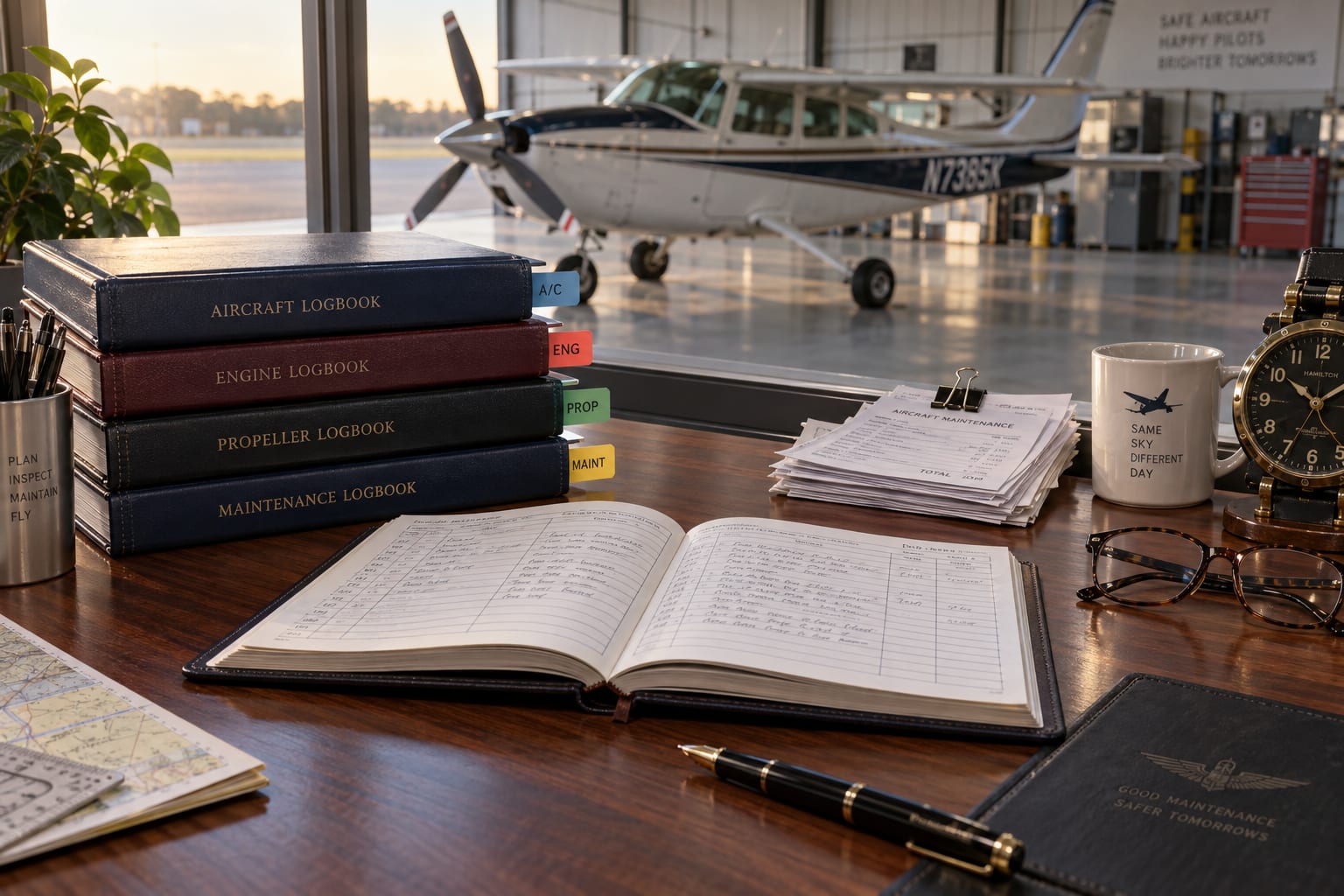
Airframe logbook tracks the aircraft's structural life, including annual inspections, major repairs, alterations, and any Form 337 work tied to the structure.
Engine logbook(s), one per engine, track time since new (TSN) and time since overhaul (TSOH), oil changes, compression checks, borescope inspections, and engine-related AD compliance. The engine log is typically the most scrutinized document during a pre-buy, because engine time and overhaul history are primary value drivers.
Propeller logbook(s), one per prop, cover prop inspections, overhauls, dynamic balancing events, and prop strike history. A prop strike that isn't documented, or one that was documented but the required teardown inspection wasn't performed, is a serious liability. Buyers and insurers pay close attention to prop logs.
Avionics and accessory records don't always live in a standalone logbook, but they need to live somewhere organized. Transponder 24-month checks, pitot-static system certifications, altimeter tests (FAR 91.411), and ELT inspections (FAR 91.207) are all required at specific intervals and must be documented and traceable.
Beyond the logbooks themselves, keep these supporting documents organized alongside them:
- FAA Form 337 for every major repair or alteration, retained permanently with the aircraft records
- STC paperwork, including the approval documentation and any flight manual supplements
- Weight and balance records, both current data and historical records showing how W&B changed with modifications
- Type Certificate Data Sheet (TCDS), the FAA's official specification document for your aircraft type
- Registration and airworthiness certificate copies (originals must be aboard when flying)
If you're inheriting an aircraft with incomplete paperwork, document retrieval services can pull digital copies of 337s, STCs, and registration records directly from the FAA registry, which is a useful starting point for filling gaps.
Building Your Physical Logbook Organization System
A good physical organization system doesn't require anything exotic, just a clear structure, the right materials, and the discipline to maintain it.
Choosing the Right Storage Approach
The original logbooks stay intact. Never disassemble, reorder, or alter original logbook entries. What you're building is a supplemental organization system that makes the original records accessible and navigable.
For most GA owners, a dedicated binder system works best. Use one binder per major category (airframe, engine, propeller, and supporting documents) and keep them together in a consistent location. A waterproof, fireproof document box stored in the hangar or at home adds meaningful protection against the scenarios that destroy irreplaceable records.
Accordion files work for portability but tend to become disorganized quickly. Original logbook binders alone, without supplemental indexing, force anyone reviewing your records to read every page sequentially. The goal is a system where you, your IA, or a prospective buyer can go directly to any specific entry or document type in under two minutes.
How to Organize Each Logbook Internally
Chronological order is the gold standard for original logbook entries, and you never rearrange them. What you can do is make them navigable.
Create a logbook index page at the front of each binder: a simple table listing date, type of entry, and page or entry number. This single document transforms a 40-year logbook from a sequential read into a searchable reference. It takes a few hours to build the first time and minutes to update going forward.
Use tabbed dividers within your supplemental binder to separate categories: Annual Inspections, Airworthiness Directives, Engine Events, Avionics Certifications, and STCs and 337s. Color-coded tabs add a visual navigation layer that lets anyone find what they're looking for at a glance. AOPA recommends keeping an up-to-date list of recurring inspections at the front of your records binder so both you and your IA have an immediate status overview before diving into the detailed entries [2].
One absolute rule: never use correction fluid in a logbook. If an error needs to be corrected, draw a single line through it, initial it, and write the correction. That's the legally recognized method. White-out in a logbook raises questions about record integrity that you don't want to answer during a sale or an FAA inspection.
Building an AD Compliance Tracking Sheet
This one document may be the single highest-value addition to your logbook system. Create a one-page summary for each applicable airworthiness directive: AD number, description, compliance method, compliance date, aircraft time at compliance, and the logbook entry reference where the sign-off can be found.
Depending on your aircraft type and age, the number of applicable ADs, recurring and one-time, can run into the dozens. A master tracking sheet means your IA can verify AD status in minutes rather than hours, and a buyer's inspector can confirm compliance without reading every page of every logbook. Keep the most current version on top and maintain older versions underneath for reference. Update this sheet every time a recurring AD comes due.
Going Digital: Scanning and Backing Up Your Logbooks
Original paper logbooks are irreplaceable. Fire, flood, theft, and simple deterioration over decades can destroy records that took 40 or 50 years to accumulate. A complete digital scan doesn't replace those originals, but it provides a recoverable copy that can support reconstruction efforts, facilitate remote review by buyers and mechanics, and give you peace of mind.
Digital copies also streamline the pre-buy process. Instead of shipping original logbooks to a buyer across the country or having them sit in a mechanic's shop for a week, you can share a complete PDF package electronically.
Use a flatbed scanner for best results. Smartphone scanning apps have improved significantly and work well for clean, modern entries, but older or faded pages benefit from a flatbed's controlled lighting. Save files in PDF format with a consistent, descriptive naming convention: N12345_AirframeLog_1978-2005.pdf and N12345_EngineLog_Vol2_2005-2024.pdf. This makes it immediately clear what each file contains without opening it.
Store copies in at least two locations: a cloud service (Google Drive or Dropbox both work well) and a local external hard drive kept somewhere other than the hangar. Consider sharing folder access with your A&P or IA so they always have a current copy before your annual.
Several platforms exist for tracking aircraft maintenance digitally. Tools like MyFlightbook and Savvy Aviation's maintenance tracking can be useful for tracking recurring items, setting reminders for upcoming inspection intervals, and generating summary reports for insurance or pre-buy purposes.
Here's the critical caveat: digital records do not replace original paper logbooks for FAA compliance or resale purposes. The original signed entries in the original logbooks are what carry legal weight. Treat digital as your backup and organizational tool, not your primary record.
Maintaining Your System and Handling Special Situations
Organization isn't a one-time project. It's a habit. The system you build only stays useful if you maintain it consistently, and the natural rhythm of aircraft ownership gives you clear checkpoints to do exactly that.
Establishing a Logbook Review Routine
The annual inspection is your primary logbook review event. Before your IA starts work, sit down together and go through the records. Confirm that the AD tracking sheet is current, that all prior entries are complete, and that any deferred items from the previous annual have been addressed or carried forward with documentation. This collaborative review catches problems before they become surprises.
After any maintenance event, verify the entry before your mechanic leaves. Check that the entry includes the date, tach or Hobbs time, a description of work performed, any parts installed with part numbers, and the mechanic's certificate number and signature. An incomplete entry is much harder to correct after the fact, and it's your responsibility as the aircraft owner to ensure the records are accurate.
Between annuals, keep a running squawk list: a simple document where you note any discrepancies, unusual observations, or deferred items as they come up. This becomes your briefing document at the next annual and ensures nothing falls through the cracks.
What to Do When You Find Missing or Incomplete Entries
Don't panic. Missing entries are more common than most owners realize, particularly in aircraft with long histories and multiple previous owners. The right response is methodical, not reactive.
Work with an experienced IA to reconstruct records where possible. Prior shop invoices, manufacturer service records, and documentation from previous owners can help establish what work was done and when. A signed statement from a qualified mechanic attesting to the aircraft's current condition can sometimes supplement missing historical documentation. FAA Advisory Circular AC 43-9D provides current guidance on maintenance record requirements and is worth reviewing with your IA when dealing with documentation gaps.
The key principle is transparency. Document the gap honestly rather than leaving it unaddressed or attempting to paper over it. An acknowledged gap with a clear explanation is far less damaging to an aircraft's value and airworthiness standing than one that looks like it might have been concealed.
Transferring Logbooks at the Point of Sale
All original logbooks and supporting documents transfer with the aircraft; they belong to the airframe, not to you as the owner. Before the sale closes, make a complete copy of everything for your personal records. This protects you if questions arise after the sale about the aircraft's condition or history during your ownership period.
Prepare a logbook summary document for prospective buyers: total airframe time, engine TSOH, recent major work, open ADs, and upcoming inspection due dates. This one document, placed at the front of your records package, gives buyers an immediate snapshot and signals that you've maintained the aircraft with care.
Special Cases: Inherited Logs, Vintage Aircraft, and Experimentals
If you buy a used aircraft and inherit decades of inconsistent recordkeeping, start with a complete inventory. Lay out every document, every binder, every loose paper, and create a master list of what exists before you try to organize anything. Once you know the full scope, identify the most critical gaps: missing annual inspection sign-offs, unverified AD compliance, and undocumented major repairs or alterations. Engage an experienced IA early in this process; an IA who knows your aircraft type can quickly assess what's missing, what's reconstructable, and what represents a genuine airworthiness concern versus a paperwork inconvenience.
For vintage and antique aircraft with original logbooks spanning 50, 60, or even 70 years, prioritize archival-quality scanning of any logbook where the physical condition is deteriorating. AOPA and EAA both have member services and technical resources that can point you toward additional support for record preservation challenges specific to older aircraft.
Experimental aircraft operate under different recordkeeping requirements than certificated aircraft. The builder's log is a foundational document for experimental aircraft, required as part of the airworthiness certification process including Phase I flight testing. FAR 91.417 applies to all aircraft including experimentals, while FAR 43.1 excludes certain experimental aircraft from Part 43 requirements. The EAA is the definitive resource for experimental aircraft recordkeeping guidance, and their SportAir workshops and technical counselor network can provide hands-on support for owners navigating these specifics.
Conclusion: Start Where You Are, Build From There
Organized aircraft logbooks protect your investment, keep you legally compliant, and make every interaction with mechanics, insurers, and buyers smoother. The system doesn't have to be complicated. A clean binder structure, an AD tracking sheet, a digital backup, and a consistent review habit at each annual covers the vast majority of what you need.
If your current records are a mess, the right move isn't to feel overwhelmed. Start with a complete inventory and a conversation with your IA. Even a partial, imperfect system is dramatically better than no system at all, and every improvement you make adds real, measurable value to your aircraft.
If you're buying or selling a GA aircraft and want to ensure the logbooks and records package is complete and accurate, a qualified aircraft broker or aviation consultant can provide targeted guidance. A thorough records review before you list, or before you make an offer, is one of the highest-return steps in any aircraft transaction.
Sources
- Heck Air – What's in a Logbook? How to Read and Maintain Aircraft Maintenance Records
- AOPA – Keep It Clean
Disclaimer: Some articles on this site are created with the assistance of AI technology.