Scimitar Props: The Curved Blade Upgrade That Could Transform Your Aircraft's Performance
Table of Contents
- What exactly is a scimitar propeller?
- The science behind scimitar propeller performance
- Performance benefits you can expect
- Noise reduction: A game-changer for many owners
- Drawbacks and limitations to consider
- Aircraft compatibility and stc requirements
- Major manufacturers and product options
- Cost-benefit analysis: Is the upgrade worth it?
- Installation process and timeline
- Real-world owner experiences and case studies
- Frequently asked questions
- Sources
What exactly is a scimitar propeller?
The distinctive curved design
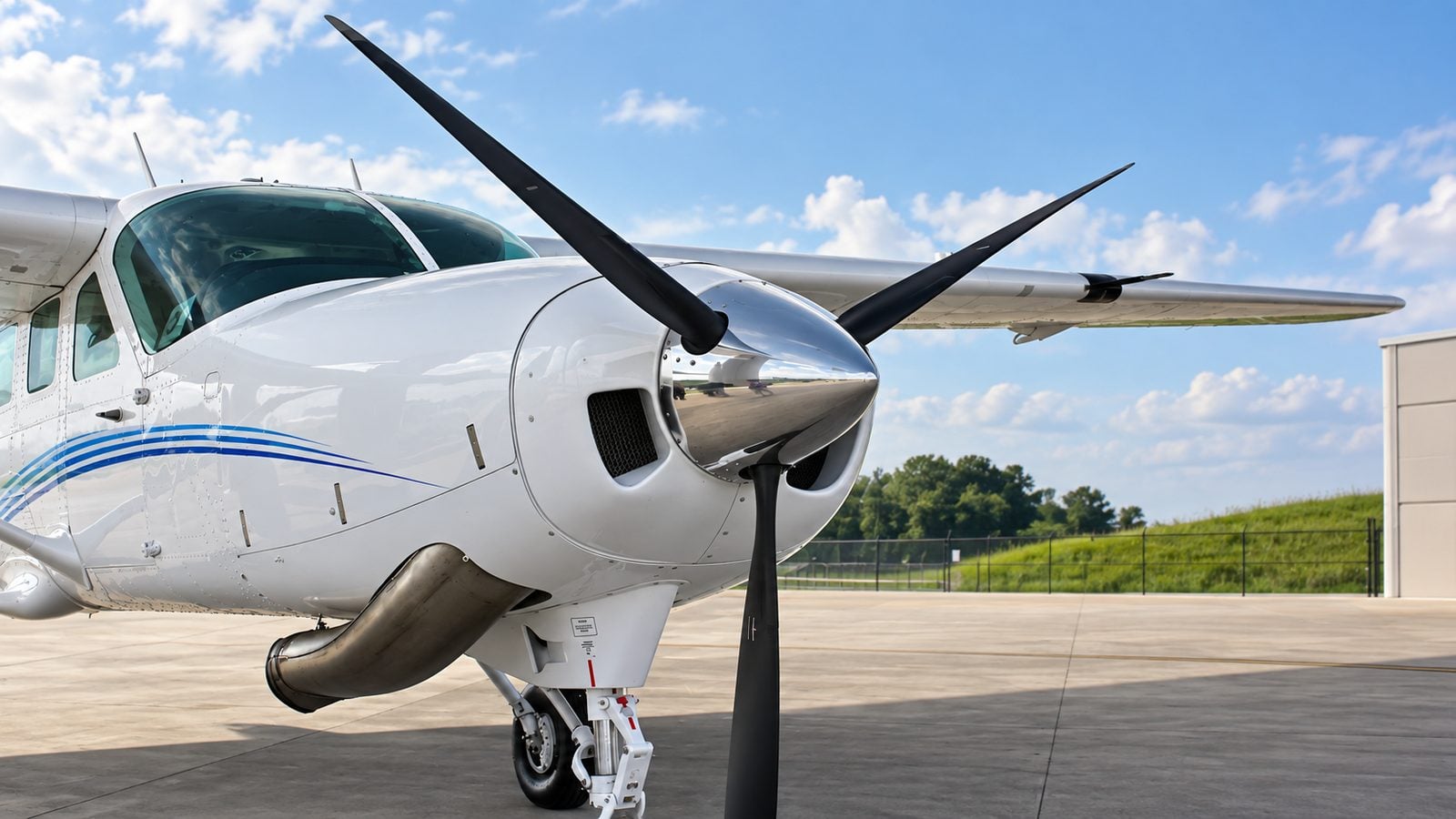
A scimitar propeller uses blades with a curved planform and increasing sweep along the leading edge—a shape reminiscent of a scimitar sword. This visual departure from the straight-bladed propellers commonly seen on general aviation aircraft is unmistakable. The "scimitar" designation comes from this unique, curved profile.
The functional origin is aerodynamic: blade sweep helps manage airflow near the tips at higher rotational speeds where compressibility and shock formation begin to add drag. Remarkably, similar blade forms date back to the early 1900s, with Lucien Chauvière’s Integrale props, and the concept remains highly relevant for modern aircraft seeking both performance and efficiency gains[1].
Key structural components
The design of a scimitar propeller centers on precise blade geometry, with prominent sweep at the tip and a smooth, flowing blade planform. Sweep angle and curvature are carefully tuned for airflow management and efficiency.
The hub used with scimitar blades typically resembles that of a standard constant-speed or fixed-pitch prop, but some newer models incorporate proprietary hub designs for weight savings or vibration damping. Modern scimitar props often utilize lightweight composites, like carbon fiber, or advanced aluminum alloys to achieve the necessary strength and resilience at reduced mass[1].
How scimitar props differ from conventional propellers
Unlike straight blades, scimitar props employ significant sweep and highly tailored blade planforms—especially at the tips—delaying and weakening shock formation as tip speed increases. These aerodynamically sculpted tips result in improved performance during high-power or high-RPM operation, when traditional props would encounter more drag due to compressibility effects. Many STC-approved upgrades use these advanced geometries on widely available certified aircraft, which reflects both technology transfer from turbine designs and manufacturer adaptation to piston types[2][3].

The science behind scimitar propeller performance
Aerodynamic principles at work
As propeller tips approach transonic speeds, shock waves begin to form. This creates efficiency loss and a dramatic rise in noise. The swept blade shape of scimitar props delays and weakens these effects, borrowing theories from the design of swept wings. Carefully engineered sweep angles, refined chord distributions, and advanced airfoil choices result in smoother airflow, reduced tip vortex formation, and improved performance, especially at high engine RPMs[1][2].
Noise reduction technology
Noise from propellers is strongly influenced by the interaction of tip Mach number, shock formation, and acoustic energy. Swept tips in scimitar props delay the formation of tip shocks, which lowers both external and internal (cabin) decibel levels. Manufacturers position scimitar props as a solution to both performance and noise, and recent designs focus intently on this aspect for community and airport relations[2].
Efficiency gains explained
Reducing drag at the tip through strategic sweep and geometric refinement means a higher proportion of engine power is converted into useful thrust, not wasted as noise, heat, or induced drag. Scimitar props often deliver observable improvements in thrust-to-power ratios, fuel consumption, and overall aircraft performance at normal cruise and climb settings. The scale of these gains varies by airframe, propeller model, and powerplant configuration[2].
Performance benefits you can expect
Enhanced climb performance
Manufacturers and owner reports often cite substantial improvements in takeoff and climb. In practice, these can range from improved thrust at lower airspeed to significant increases in rate of climb—sometimes several hundred feet per minute, depending on the installation. Gains are generally more pronounced at higher density altitudes or aircraft gross weights, where airflow management at the blades’ tips is critical[2][3].
Cruise efficiency improvements
With refined blade shapes, scimitar props can provide higher cruise speeds at the same engine power setting, or deliver measurable reductions in fuel consumption per nautical mile. This translates into possible range extension, especially on longer flights or for owners who routinely operate near gross weight[2].
Takeoff and landing characteristics
Shorter takeoff distances and better ground clearance are often noted after upgrading to a scimitar prop. In many cases, pilots also observe smoother ground roll, improved acceleration, and more responsive low-speed handling. The degree of benefit is determined by the specific airframe, prop model, and STC certification[3].

Noise reduction: A game-changer for many owners
Quantified noise improvements
Typical noise reductions cited by manufacturers and supported by select test data include external decibel (dB(A)) reductions of several points compared to straight-blade props—enough to be perceptible on the ramp and in the cockpit. In many installations, frequency spectrum analysis also reveals a reduction in the harshest or most fatiguing noise bands, modernizing both cabin comfort and external sound profiles[2][5].
Benefits for airport relations
The lower noise signature associated with scimitar props helps with community acceptance, eases compliance with noise-certification standards, and may open access to airports with strict noise abatement requirements. Organized fly-ins and residential airparks frequently note reduced noise complaints when aircraft feature advanced tip propellers[5].
Enhanced passenger comfort
Feedback from pilots and passengers highlights how cabin noise and vibration can drop noticeably after a scimitar prop conversion. Some owners also report clearer intercom communication, less stress fatigue on long flights, and a generally higher perception of comfort—even when objective noise reductions are moderate[4].

Drawbacks and limitations to consider
Initial investment costs
A scimitar propeller installation represents a significant upfront expense. Purchase prices vary by aircraft, blade count, and material, but are typically higher than direct-replacement props. Add to this the installation labor, governor compatibility checks, and any STC or certification fees. Still, dedicated conversion programs and broad STC coverage can simplify approval and streamline installation on many aircraft[3].
Maintenance and inspection requirements
Many scimitar props use advanced materials and manufacturing methods, which can require specialized maintenance or repair. Some composite models call for different inspection intervals or access to proprietary service centers. Parts availability, especially for newer or less common blades, may also affect ongoing operating costs and service turnaround times[3].
Performance trade-offs
Certain scimitar STCs may impose diameter restrictions, placards, or operating limitations (such as restricted RPM ranges) for noise or power absorption reasons. While blade sweep can compensate for reduced diameter, excessive diameter reduction could impact maximum power transfer. Owners should also assess any handling or ground clearance changes, and consult model-specific data and experience reports[5].
Aircraft compatibility and STC requirements
Popular aircraft models with available STCs
Scimitar props are available, via approved STCs, for dozens of piston and turboprop models. This includes many Cessna singles, Piper Archer and Saratoga models, Beech Bonanzas, numerous twins, the Pilatus PC-12, and turboprop aircraft such as the Daher TBM series[3].
Certification process overview
Installing a scimitar propeller almost always requires a Supplemental Type Certificate (STC) for certified aircraft. The STC process covers installation approvals, placards, performance data, and ensures compatibility with existing engines and systems. Shops performing these upgrades must follow all documentation and regulatory requirements provided by the prop manufacturer and the FAA[3].
Alternative certification paths
In rare cases, field approval or experimental category installations may allow use of advanced blade designs prior to formal STC development. However, STC upgrade kits remain the preferred—and typically only—pathway for most registered general aviation aircraft[3].
Major manufacturers and product options
Leading manufacturers
Hartzell Propeller is the best-known producer of STC’d scimitar props for piston and turboprop models. Their Top Prop line includes multiple conversion kits with documented efficiency, smoothness, and noise benefits. MT-Propeller and McCauley also offer scimitar options for certified and experimental types. Distributors like D'Shannon market advanced tip designs for specialty noise control or diameter management[2][3][5].
Model-specific recommendations
High-performance singles often benefit most from multi-blade scimitar conversions, which can maximize climb, cruise, and cabin quiet. Twins can also show gains when matched with model-specific kits, especially if noise or smoothness is a higher priority. For turboprops, advanced tip shapes are frequently incorporated for both thrust and noise control[2][5].
Warranty and support considerations
Warranty terms and technical support levels vary by manufacturer and distributor. Hartzell, McCauley, and MT-Propeller each provide multi-year coverage on materials and workmanship, along with extensive national and global support networks. Always verify that your installer is authorized, and confirm post-installation service availability for your aircraft type[3].

Cost-benefit analysis: Is the upgrade worth it?
Break-even calculations
Many owners approach the upgrade with a cost/benefit mindset: Will lower fuel burn, higher speed, and improved utility justify the investment? Manufacturer claims often suggest measurable fuel savings over time, potential operational cost reductions, and a positive impact on resale value for upgraded aircraft. Exact break-even timelines will depend on mission profile, flying hours, and each aircraft's baseline performance[2][3].
Quantifying intangible benefits
Intangible benefits—such as quieter operations, greater passenger comfort, and short-field performance—may be as valuable as hard operational savings for many owners. These factors add to utility and owner satisfaction, even if not directly reflected in typical return-on-investment models[4].
Financing options
Propeller upgrades may qualify for financing with aircraft lenders, and some owners leverage tax deductions for business use or lease-back operations. Consult with aviation finance experts for current terms and to understand any local or federal tax implications.
Installation process and timeline
Pre-installation requirements
A typical upgrade begins with an inspection to confirm compatibility, review airframe logbooks, and determine any modifications needed—such as for the governor or spinner. Parts ordering and kit arrival can take several weeks, depending on the model and manufacturer backlog[3].
Installation procedure overview
Installation itself usually takes one to two shop days if no major modifications are needed. Steps include removing the old prop, fitting the new hub and blades, ensuring correct torque and safetying, addressing the governor if required, and installing any placards. Post-installation testing verifies smooth operation and leak-free connections[3].
First flight and break-in process
After installation, pilots follow a break-in and post-maintenance testing profile: measuring static RPM, verifying governor operation, and closely tracking climb and cruise numbers over several flights. This step is vital to accurately document before/after performance and confirm installation success[3].
Real-world owner experiences and case studies
Performance improvement examples
Owner feedback frequently validates claims of smoother operation, quieter cabins, and improved performance. For example, Piper Owner Society reviews of the McCauley scimitar three-blade prop noted quieter operations, less vibration, and the absence of restricted RPM ranges on specific installations—a field report for that airframe and propeller combination[4].
Common installation challenges
Some owners highlight minor issues during installation, from spinner fit to slight governor adjustments. These are generally resolved with manufacturer support and by following the STC documentation—including placards and performance verification flights. Lessons learned from early adopters emphasize using experienced shops.
Long-term satisfaction rates
Anecdotal owner satisfaction remains high for scimitar prop upgrades—especially when expectations are set by documented performance data and the target installation is supported by a mature STC kit[4].
Frequently asked questions
How much does a scimitar propeller typically cost compared to a standard replacement prop?
Will installing a scimitar prop void my aircraft's warranty or affect insurance?
How much noise reduction can I realistically expect from upgrading to a scimitar propeller?
Are there any aircraft that shouldn't use scimitar propellers?
How long do scimitar propellers typically last compared to conventional props?
We promise we don't send spam
MEET HPA
FOLLOW US